
Project Description
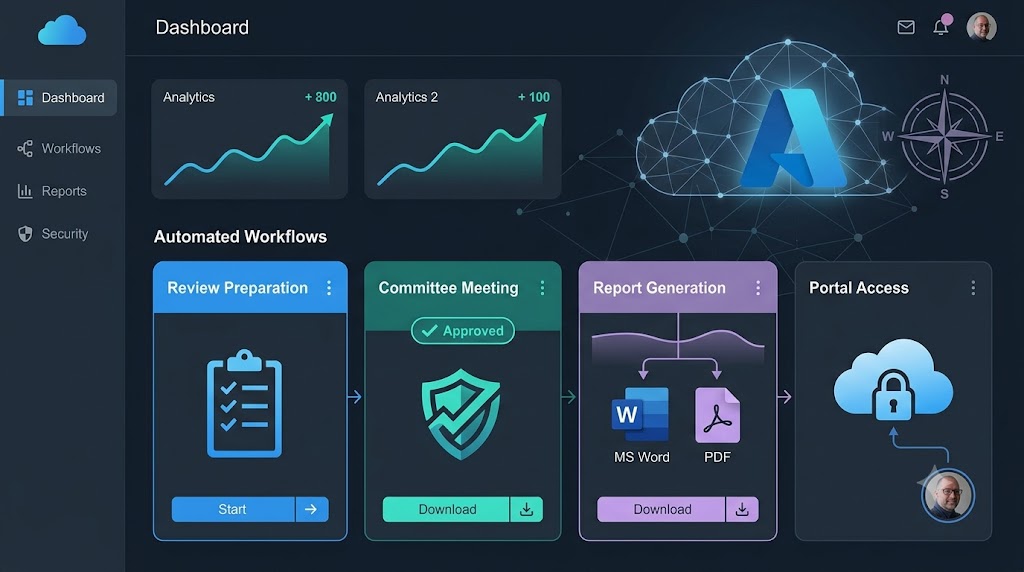
The project involved reimagining a 2010-era Windows desktop application into a high-performance React single-page web application hosted in the Microsoft Azure cloud. It was extended for a companion regulatory body to replace their legacy review software and automate previously manual processes. During this engagement, I was heavily involved in optimizing the regulatory review process, specifically focusing on the committee review workflows required for finalizing review results, as well as developing the companion portal to allow practices to securely interact with the review process.
Key phases and milestones of the project included:
- Committee Preparation
- Running the committee meeting
- Entering results from the committee meeting
- Finalizing the reviews and ending the review cycle
Key deliverables produced for this project included:
- Functional workflow diagrams
- Architectural diagrams and documentation
- Admin & User manuals
- User training programs
My Approach
Acting as a trusted technology and business advocate, I led continuous discovery workshops to map current versus future states and prioritized a backlog of modifications and new features. To define the new system, we worked through the existing legacy system’s data structures and layered the desired future business processes on top of them. This analytical approach allowed us to easily identify gaps in the current data and pinpoint exactly where business logic needed to be changed or added during the rebuild.
We heavily utilized user story mapping, process flow mapping, and clickable prototyping (using Figma and FigJam) to bridge knowledge gaps between business processes and technical functionality. Because we did not always have access to a large group of end-users for validation, we relied heavily on key Subject Matter Experts (SMEs) in each area. Acknowledging that this could lead to invalidated assumptions during initial testing, we built a rigorous User Acceptance Testing (UAT) process. This strategic UAT phase was designed with enough runway to allow the team to identify, address, and resolve any functional deficiencies without jeopardizing the project timeline.
Methodology: Agile software development, Scrum framework, Continuous Discovery, Minimum Viable Product (MVP), and Design Thinking
Overview
| Project Summary: Led the modernization and expansion of a legacy regulatory review system into a secure, high-performance cloud workflow platform for regional professional regulatory bodies |
| Project Challenge: The client needed to replace an aging, fragmented system and manual processes with a secure, centralized cloud solution capable of managing complex workflows, annual budgeting, and highly sensitive document handling. |
| My Role: Senior Product Owner Senior Business Analyst |
| Stakeholders: Client Executives Review Committees Reviewers Professional Members Key Subject Matter Experts (SMEs) Development Squad |
| Key Technologies: .NET Core ASP.NET Core C# GraphQL React TypeScript Material UI (MUI) Azure (SQL Database, Functions, Key Vault, Service Bus, SignalR) Microsoft 365 (Exchange Online, SharePoint Online, Power BI, Azure AD) Aspose Words |
Project Outcome
The modernized web-based system was successfully launched and incrementally rolled out with new functionality over 10 months. The system successfully standardized the completion of checklists, automatically generated MS Word and PDF reports, and securely managed the exchange of highly sensitive information.
Key Decisions: Transitioning from an offline-capable on-premises architecture to a fully cloud-driven Azure web application to eliminate technical debt and match up-to-date business processes. Deciding to build a separate but architecturally similar single-page application for the member portal to ensure highly secure document handling, sharing authentication with the client’s existing member portal.
Business Impact: The system ultimately improved operational efficiencies across the organizations and significantly improved data accuracy. Due to client preferences, quantitative results were not strictly measured; however, success was evaluated against key performance indicators (KPIs) such as the time it took to complete a review and the time required to prep for a committee meeting. Qualitative feedback was continuously gathered and integrated via sprint demos, rigorous UAT testing, and limited production release groups.
Lesson Learned: Relying solely on key SMEs can lead to invalidated assumptions; the more end-users you can engage with to validate functionality early on, the higher the quality of the initial software releases will be.